

The Consolidated Half-Year Financial Report as at 30 June reports a 16% increase in net profit and a 56% rise in investments, higher than in the previous period. The operational and financial soundness has been confirmed and the targets for the current year with regard to external growth have already been achieved in the first half. The results achieved at the end of June will enable the multi-utility to further enhance its infrastructure in the second half of the year and seize new development opportunities.

Economic and financial highlights
- Revenues adjusted* at €6,494.6 million (-3%)
- EBITDA adjusted* at €715.5 million (+7.5%)
- Net profit attributable to shareholders adjusted* at €227.6 million (+15.8%)
- Investments of €652.5 million, up 56%
- ROI adjusted* at 9.4% and ROE adjusted* at 10.9%
- Net financial position at €4,248.6 million, with a net debt/EBITDA ratio of 2.75x
The Hera Group's Board of Directors, chaired by Executive Chairman Cristian Fabbri, today approved the consolidated results as at 30 June 2026, which show a positive structural performance, with margins and net profit up compared to the same period of the previous year. The growth is even more significant if the results are compared with the first half of 2025 adjusted.
The results achieved highlight the Hera Group's ability to operate effectively even in a macroeconomic and geopolitical environment characterised by elements of uncertainty. The continuation of international tensions and the volatility of the energy markets did not affect operations, which recorded an improvement in gross margins and operating profit or loss compared to the first half of 2025, confirming the solidity of the business model and the constant generation of value.
The group’s business strategy, based on a balance between regulated and free-market activities, remains a key element for addressing the challenges anticipated for the remainder of 2026. The diversification of businesses and the ability to promptly seize the opportunities offered by the market make it possible to pursue the industrial growth and sustainability objectives defined by the Business Plan, confirming the solidity and flexibility of the Group's business model.
With reference to growth opportunities through M&A, during 2026 the multi-utility further strengthened its presence, especially in waste management, through the acquisitions of the Sostelia Group, one of Italy's leading operators specialising in industrial and civil water treatment technologies and services, and of control of Servizi Ecologici Ambientali (SEA), which operates a multifunctional special waste storage and treatment facility located in Camerata Picena (Ancona).
Cristian Fabbri, Executive Chairman of the Hera Group, stated:

"The results achieved by the Hera Group as at 30 June 2026 confirm the strong impetus for growth provided by the Business Plan. The more than 7% increase in EBITDA on a like-for-like basis compared with the first half of 2025, is supported by all business lines and highlights the strength of the business portfolio, despite a complex external environment. The acceleration in investments, which exceeded 650 million euro, up by more than 50% compared to 2025, testifies to the Group’s ability to continue its path of external growth through M&A and infrastructure development, as reflected by the fact that 65% of EBITDA is generated by infrastructure businesses, 44% of which are regulated. The significant increase in development capex, which exceeded 800 million euro over the last 18 months, is only partially reflected in the results achieved in the first half of the year and constitutes a visible reserve of value to support future growth. The increase in net profit, in line with analysts' estimates before the IRAP surcharge, and the 9.4% return on invested capital highlight the Group's consistent focus on value creation.”
Orazio Iacono, CEO of the Hera Group, stated:

“In the first half of 2026, the Group achieved further improved economic and financial results compared to the corresponding period in 2025, despite a macroeconomic environment characterised by persistent elements of uncertainty. Net profit attributable to shareholders amounted to 227.6 million euro, up 15.8% compared to the like-for-like figure for the first half of 2025. This trend confirms the Group's ability pursue growth and transferring it down to the bottom line of the P&L. The acceleration of investments, both organic and for the M&A of Sostelia and SEA, was supported by the solid operating cash flows, exceeding 700 million euro in the first half of 2026. The strength of the capital structure is confirmed by a net financial position/EBITDA ratio of 2.75x, a figure that also incorporates the effects of the annual dividend recent distribution and shows ample room to fund further growth opportunities."
Revenues adjusted at €6.5 billion
Revenues for the first half of the year amounted to €6,494.6 million, compared to €6,645.0 euro as at 30 June 2025, mainly due to the reduction in volumes in the last resort markets and Consip.
EBITDA adjusted up 7.5%
EBITDA as at 30 June 2026 stood at 715.5 million euro, up 7.5% compared with the first half of 2025 adjusted thanks to the contribution of all business areas. 65% of EBITDA adjusted is generated by the two infrastructure business areas, Networks and Waste.
EBIT adjusted rises
EBIT as at 30 June 2026 rose to 386.5 million euro, recording double-digit growth (+14.7%) when compared with the adjusted value for 2025. This result is due to normalised provisions, which offset higher depreciation and amortisation related to infrastructure growth.
Net profit attributable to shareholders adjusted up 15.8%
Despite the increase in the tax rate to 29.5%, compared with 29.0% in the first half of 2025, due to the increase in IRAP for the 2026-2027 period introduced by the Bollette Decree, adjusted net profit as at 30 June 2026 rose to €245.8 million, up 13.5%. Likewise, adjusted net profit attributable to the Group's shareholders increased to €227.6 million (+15.8%), compared with the adjusted result for the first half of 2025. Excluding the IRAP surcharge, net profit attributable to the Group's shareholders adjusted would amount to €232 million, in line with analysts' consensus estimates. All these results once again confirm value creation for all stakeholders, fully in line with the expectations set out in the Business Plan.
Investments up 56% and further strengthening of the Group's solidity
In terms of capital expenditures and investments, the Hera Group also recorded significant growth compared to the previous year, confirming its commitment to expanding infrastructure and strengthening the resilience of the assets under management, and to promoting technological evolution in support of the green and digital transition.
In particular, operating capital expenditures in the first half of 2026, including capital grants, rose to 510.5 million euro (+23.3%) compared to 414 million euro at 30 June 2025.
In addition to operating capital expenditures, there were investments for M&A relating to Sostelia and SEA amounting to 142 million euro.
The net financial position stood at 4,248.6 million euro, up from 3,944.4 million euro as at 31 December 2025, with a net debt/EBITDA ratio of 2.75x, confirming the financial strength and flexibility of the multi-utility, which will be able to continue to seize further growth opportunities, both organic and through M&A.
Sustainability: shared-value EBITDA is growing, reaching almost 60% of the total
In the first six months of the year, shared-value EBITDA, relating to business activities that also contribute to the objectives of the Global Agenda, rose to 435 million euro, accounting for 59.9% of total EBITDA, up one percentage point compared with the same period in 2025.
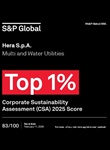
The Hera Group has continued to work intensively to combine its growth strategies with the generation of value in the medium and long term, as confirmed by the numerous milestones achieved: from the inclusion of Hera’s stock in the FTSE4Good Index Series for the seventh consecutive year, for its active commitment to sustainable development, to first place in the ESG Identity Corporate Index 2026, obtained for the integration of ESG factors into its strategy, governance and corporate culture.
For further information:
Press release
Visit Investors web area
* To provide a clearer view of the Group's underlying performance, the "Adjusted" figures include certain adjustments to the 2025 and 2026 reported results, as shown in the table attached. For further details, please refer to the section "Reconciliation of special items with the financial statements" in the Half-Year Financial Report.
Hera Group and Saipem's CO₂ capture project will receive nearly €24 million from the EU Innovation Fund
It will be the first industrial-scale example of CCS applied to a plant of this type in Italy. The project is one of the main decarbonization levers in the multi-utility's Climate Transition Plan to reduce internal emissions

Capturing carbon dioxide emitted from the waste-to-energy plant’s chimneys and storing it in depleted natural gas fields, thereby significantly reducing plant emissions while contributing to the decarbonization of local areas. This is the goal of the pioneering project for the Ferrara plant - proposed by Hera Group, as the lead partner, in collaboration with Saipem - that has been selected to receive funding under the fourth call for mid-scale projects from the EU Innovation Fund. Once the allocation is finalized, the funding for the CO₂ emission capture project will amount to nearly €24 million.
This industrial CO₂ capture project is the first of its kind in Italy designed for waste-to-energy plants and among the first in Europe. It involves the application of Bluenzyme™️, Saipem's proprietary and modular solution based on “CO₂ Solutions”, an innovative enzymatic technology for capturing carbon dioxide in industrial processes of small and medium emitters.
The initiative was selected by European authorities for its high level of innovation, and its potential replicability in other waste-to-energy plants and other hard-to-abate industrial sectors in Italy, and more generally across Europe. The European Funds will cover a significant portion of the €53 million planned for the construction of the CO₂ capture plant. Depending on opportunities arising from changes in the regulatory framework, the plant is expected to be operational by 2028.
The project will fully abate CO₂ emissions from the Ferrara waste-to-energy plant
CO₂ capture is a crucial decarbonization tool for waste-to-energy plants, and for now, the Herambiente plant in Ferrara has been identified as the most suitable. The project will enable, in fact, the capture of approximately 90% of the emissions from one of the plant's two lines, amounting to 64 thousand tons of CO₂ per year (equivalent to the annual emissions of around 37 thousand cars), which represent the entirety of the CO₂ emitted, making the entire energy production from the waste-to-energy process sustainable. The remaining share of the CO₂ emitted by the plant is biogenic in nature and therefore environmentally neutral. The captured CO₂ will be transported via pipeline and stored in the depleted gas fields of the Northern Adriatic. The new CO₂ capture plant will ensure high standards of safety and innovation, while maximizing energy efficiency. It will be entirely green, as it will exploit renewable energy, both generated from the waste-to-energy plant itself and from geothermal heat delivered through the multiutility’s district heating network. The enzymatic capture process, with a low environmental impact, can be powered by low-temperature heat, such as geothermal heat. Further CO₂ emissions will therefore be avoided.
For further information
Press release

.jpg/e0343881-9348-c7ba-2bc8-3aaf579491fe "sedeBO_110 (1).jpg")


.jpg/956c43c0-1a00-2a4b-b8e9-3e48b9d1105b "box110x150_BP2025_ENG (1).jpg")